

The Artemis II Rocket Mission is shaping up to be one of the most influential and highly anticipated space events in decades. For the first time since the Apollo program in the early 1970’s, humans will travel around the Moon. Artemis II will carry four Astronauts on a 10 day journey around the Moon before returning safely to Earth. The crew will travel aboard the Orion spacecraft, which sits atop of NASA’s most powerful Space Launch System (SLS) rocket. Together, Orion and the SLS will send humans even farther into space than ever before. This mission is an essential step in the developing humanity’s future in space and further exploration of the cosmos we inhabit.
Four astronauts have been chosen for this historic mission: Commander Reid Wiseman (NASA), Pilot Victor Glover (NASA), Mission Specialist Christina Koch (NASA),and Mission SpecialistJeremy Hansen (Canadian Space Agency). Artemis II will be the first crewed mission to travel beyond low Earth orbit in more than 50 years. STA Physics teacher, Ryan Chikerotis, confirmed “ Technology has definitely advanced quite a lot in the 50 years since the last lunar mission.” The mission also marks several historic milestones. Christina Koch will be the first woman to travel beyond low Earth orbit, Victor Glover will be the first person of color to make this journey, and Jeremy Hansen will be the first non-American astronaut to leave Earth’s orbit.
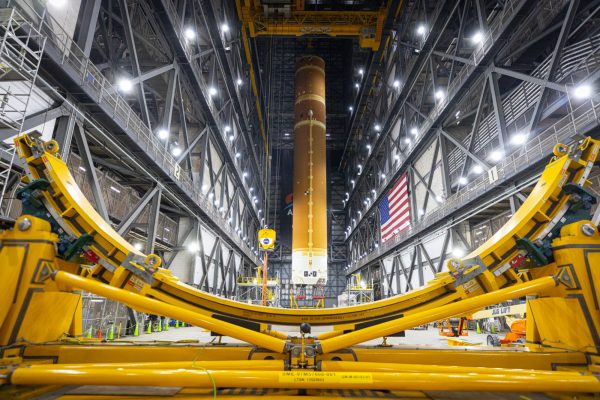
NASA originally aimed for a February 2026 launch, but Artemis II has been delayed due to several technical issues that must be resolved in order to ensure the safety of the mission crew. Even a minor issue can jeopardize a space mission. During testing, engineers conducted a procedure known as a “Wet Dress Rehearsal,” in which the rocket is fueled with liquid hydrogen and liquid oxygen while the full launch sequence is simulated. This test allows engineers to confirm that all systems are functioning properly before liftoff. However, multiple issues were discovered. A significant liquid hydrogen leak was detected in the rocket’s propellant system, forcing the team to halt the test. Engineers also identified a problematic valve and intermittent communication issues between the rocket and ground control. Hydrogen leaks have been a recurring challenge in the Artemis program, even during preparations for Artemis I. As a result, NASA has carefully investigated and addressed these concerns to prioritize the safety of the crew. The mission is now scheduled to launch no later than March 2026.
The primary objectives of Artemis II are both ambitious and necessary. The mission aims to safely carry a crew of four astronauts aboard NASA’s biggest rocket, travel around the Moon without landing, and return safely to Earth after approximately ten days in space. Chikerotis commented “Once you’re in space it’s pretty much your planned trajectory carrying you forward…it’s all Isaac Newton.” Although Artemis II will not land on the Moon’s surface, orbiting the Moon is crucial for testing NASA’s life support systems, navigational systems, and other important technological developments that are needed for future missions. The success of this mission will pave the way for Artemis III, which is planned to land astronauts on the Moon’s south pole. In many ways, Artemis II represents more than just a mission—it symbolizes the continued evolution of human exploration as we push beyond our limits and reach for the stars.





Isabella Albensi • Feb 25, 2026 at 9:35 am
Very interesting information!
riley • Feb 23, 2026 at 5:20 pm
This is very cool!